How Work Moves Through Your Company
The path a request follows from the moment it arrives to the moment proof comes back.
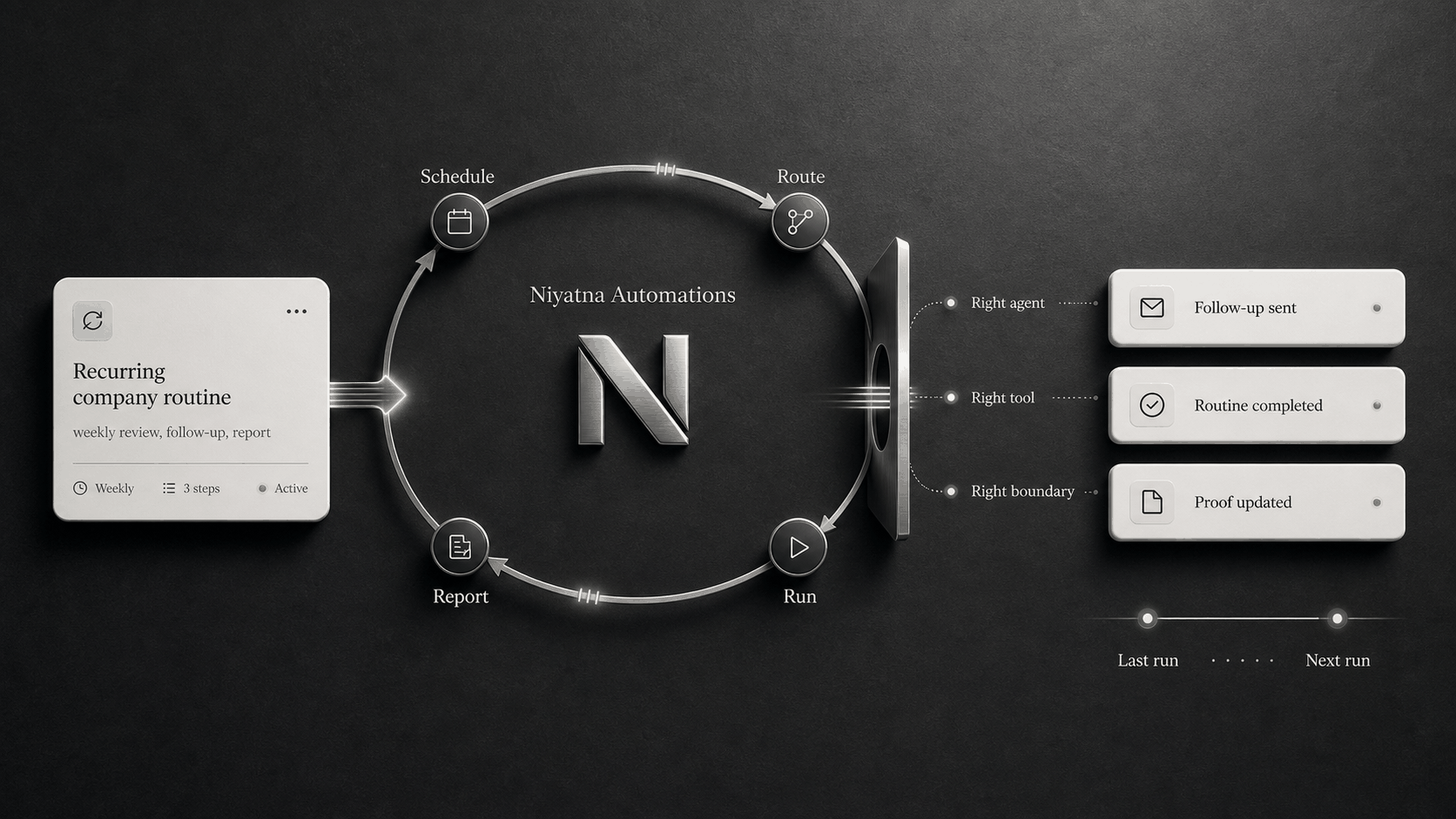
Every piece of work in Niyatna follows the same simple path, from the moment a request arrives to the moment the result comes back. Agents carry work forward, but they stay bounded by their role, their context, their permissions, and the proof they must return.
The path
- Intake. The request arrives with its goal, context, permissions, and what "done" means.
- Matching. Niyatna picks the right person, agent, or tool for the job.
- Execution. The work gets done inside the agreed scope.
- Check. The result is gathered and compared against what was asked for.
- Review. Anything risky or outward-facing pauses for a human to approve.
- Report back. The result, the proof, and anything worth remembering return to the company.
Bounded autonomy
Agents can use powerful tools, but their authority stays legible. At every point the company should be able to say what the agent was asked to do, what it touched, and what proof it returned.